On Sirajul Alam Khan’s 85th birthday, a discussion on Sirajul Alam Khan’s politics and state philosophy, future Bangladesh lies in Sirajul Alam Khan’s theory: Abu Saeed Khan
On Sirajul Alam Khan's 85th birthday, a discussion on Sirajul Alam Khan's politics and state philosophy, future Bangladesh lies in Sirajul Alam Khan's theory: Abu Saeed Khan
Hakikul Islam Khokan
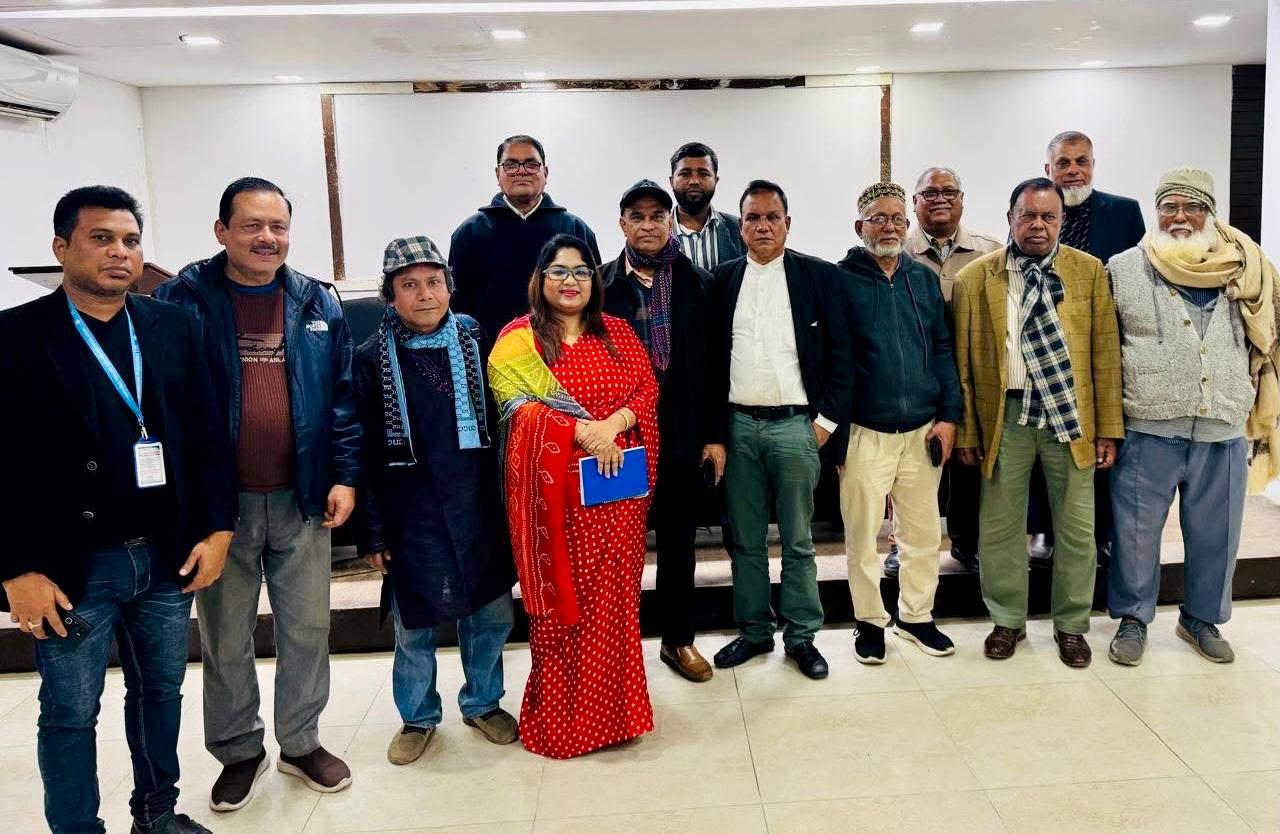
On the occasion of the 85th birth anniversary of Sirajul Alam Khan, one of the founders of the freedom struggle, one of the organizers of the liberation war and the head of the nucleus, Sirajul Alam Khan (SAK) Foundation and Research Institute organized a discussion meeting titled 'Politics and State Philosophy of Sirajul Alam Khan' at Zahur Hossain Chowdhury Auditorium of Dhaka National Press Club on Thursday (January 8) afternoon. Khabar Ibn News president's speech, chairman of the foundation, prominent freedom fighter, journalist, writer and political analyst Abu Saeed Khan said - "Future Bangladesh is hidden in the theory given by Sirajul Alam Khan, one of the organizers and nucleus head of the liberation war, the epic character of history. Sirajul Alam Khan is still relevant for building future Bangladesh. He should be remembered. He said, "The biggest voice of the anti-discrimination movement of the 24th was to end discrimination." But discrimination has not ended in the last 17 months, rather it has increased. Surely we have to think anew. I want to build Bangladesh with the desire of the 71st liberation war, the desire of the 90th and 24th July coups. There will be an end to discrimination between people, there will be no differences between religions - Bangladesh, which we wanted in 1971; The kind of Bangladesh that I dreamed of through the July coup; Realizing that dream is now the big demand of the time. If we can build a livable, non-discriminatory Bangladesh for all, then the lives and memories of Sirajul Alam Khan and others who sacrificed their lives will be honored and glorified.
He said, "The young Sirajul Alam Khan thought about independence in the sixties. Abdur Razzaq formed an organization known as 'Nucleus' with Kazi Aref Ahmed. When Bangabandhu Sheikh Mujibur Rahman gave 6 points in 66, a new door was opened to realize the dream of Sirajul Alam Khan. He took a vow to turn six points into one point (of independence). He succeeded in that. He organized the workers in the much-discussed strike for autonomy in 1966. Sirajul Alam Khan 69-Abu Saeed Khan, who wrote the mass uprising, said, "The mass uprising of 1969 is the basis of the liberation war of 1971. Various activities were undertaken to advance the movement of self-rule to the pinnacle of independence. Sheikh Mujib called for non-cooperation movement. Sirajul Alam Khan understood that Yahya cannot be dealt with through non-cooperation movement. He took armed preparations. Quoting from the writings of Kamruddin Ahmad, Abu Saeed Khan said, "In January (of 1969), the movement was divided into two parts. Bangabandhu Sheikh Mujibur Rahman was conducting the non-cooperation movement from No. 32 (Dhanmondi) in one day. On the other hand, armed war was being prepared under the leadership of Sirajul Alam Khan from Zahurul Haque Hall of Dhaka University. Training was being given to boys and girls of Chhatra League. Instructions (for armed training) were also sent across the country. At that time we also did not participate in the training from Faridpur. Sirajul Alam Khan contributed to the armed liberation war by forming the BLF (Bangladesh Liberation Force) of four leaders. He said, "Sirajul Alam Khan realized during the independence movement that the cherished dream of independence has not been realized yet." Many tasks remain unfinished. So he then called for a revolutionary national government. Bangabandhu Sheikh Mujibur Rahman formed a party government. What party government is that government? The part that did not play a role in the liberation war. He formed the government with Khandkar Mushtaq Ahmed, Taheruddin Tagore excepting Tajuddin Ahmad. That government was a government of conspirators. Bangabandhu Sheikh Mujibur Rahman was brutally killed in the conspiracy of those conspirators.
He also said, 'Sirajul Alam Khan dreamed of changing the state system. Talked about revolutionary change, and also thought about how to change this state apparatus consistently. He presented it to everyone through various booklets. He thought it wouldn't happen with Jasad alone. So he contacted all parties. Even the dictator contacted Ershad whether local government can be formed or not. Later Ershad formed the local government. BNP through the hanging of Colonel Taher-Jasdar's distance with Ziaur Rahman started. Despite this, he offered to form local government, village government with Ziaur Rahman. He understood that party politics and state politics are different. National politics should be done together. That is why he not only engaged himself in Jasad. He spoke as a political philosopher out of the jail. He presented that statement in front of the government, the opposition party.
Freedom fighter, former student leader, Central General Secretary of Bangladesh Jasdar Nazmul Haque Pradhan said - 'There is no way to deny that Sirajul Alam Khan is our father. He can be discussed in three parts and each part is very important. The first was in the 60's when the Bengali nationalism movement was growing and moving towards a specific goal and towards emancipation. Although Bangabandhu Sheikh Mujibur Rahman was the leader of the people there, but our leader in the field and inside was Sirajul Alam Khan. Everyone who writes textbooks or knows history admits this. He has a role in everything including Jai Bangla slogan, Desh Swadhin. But unfortunately those who have been retracing the history of liberation war for so long would not admit it.
Nazmul Haque Pradhan said that after the independence of the country, the second chapter of Sirajul Alam Khan came forward. How will this newly independent country work? He wanted this country to run by new laws, new ideas. He wanted a national government to be formed but unfortunately those who were then in power did not understand and did not accept it. They wanted everyone to just say 'yes yes' to their words. But Sirajul Alam Khan was reluctant to accept it because he believed that democracy is not only about 'yes' but also about being able to say 'no'. He believed that democracy means being able to express one's opinion without being influenced by anyone else. This is why Sirajul Alam Khan formed a political party called Jatiya Samajtantrik Dal-
© সর্বস্বত্ব স্বত্বাধিকার সংরক্ষিত