Sheikh Hasina’s era in politics ends – reality and confusion
Sheikh Hasina's era in politics ends - reality and confusion
Hakikul Islam Khokan
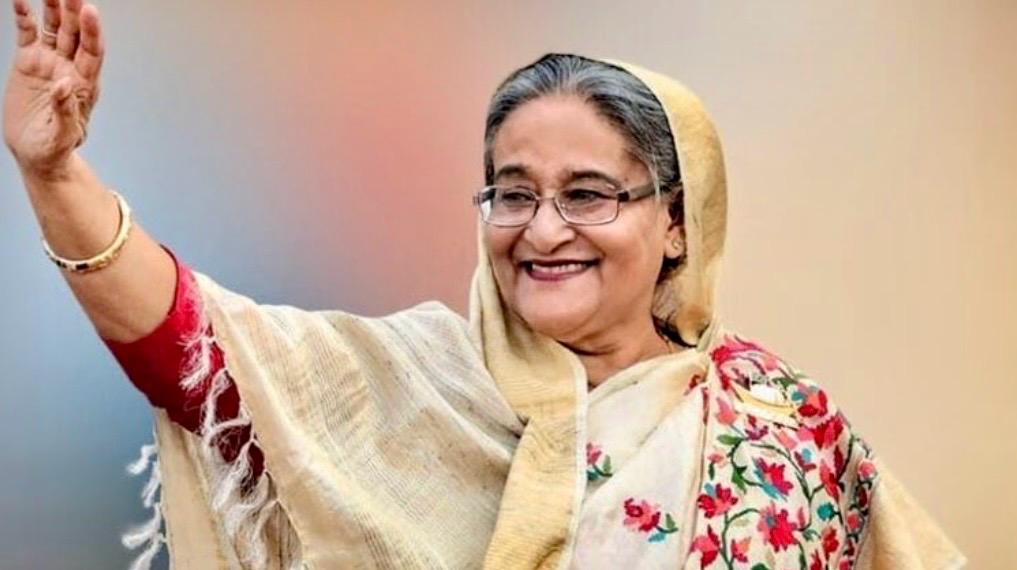
Bangladesh's ousted five-time successful prime minister and Awami League president Sheikh Hasina.
Sheikh Hasina's only son, Sajib Wazed Joy, who lives in Virginia, a state near Washington DC, gave an interview to Al Jazeera about the "end of the Sheikh Hasina era" topic. As interest has been generated in the political arena around this statement, there is no less confusion. Because Sheikh Hasina is not just the name of a time or phase in Bangladeshi politics, she is a political reality, especially in the case of Awami League.
Sajeeb Wazed Joy's interview can therefore be seen as an indication of future politics, not as a final decision or reality. In politics, the actual organization, psychology of workers and power structures are far more important than rhetoric. In those judgments, Sheikh Hasina is still the most influential political reality of Awami League.
Another important point here is that Sheikh Hasina's politics is not only related to the party but also to the experience of state power. He has been active for a long time in development, infrastructure, international diplomacy, security and administrative management. Creating alternative leadership from this experience is not an easy task for Awami League. The party is yet to establish a clear and acceptable framework on the question of succession. As a result, no matter how much discussion there is about the future leadership, Sheikh Hasina's alternative is not visible in the current politics.
Awami League is not just a party in Bangladesh politics. It is a historical continuum, whose roots stretch back to the language movement, the freedom struggle and the liberation war. The leadership of the party has changed repeatedly during this long journey, but since 1981, Sheikh Hasina has been the focal point around which the party has reorganized, returned to power and gained experience in running the state. As a result, Awami League's politics has been inextricably linked with Sheikh Hasina's personality, decisions and leadership.
Sajib Wazed Joy is giving an exclusive interview to Al Jazeera.
There is no denying that there are strong senior leaders within the Awami League.Each of them has its own ring, there are long-tested organizers. But the reality is that these circles ultimately work around Sheikh Hasina's leadership. Sheikh Hasina is the last refuge in party crisis, fear of division or difficult political moment. The place of passion and faith of the workers-supporters also stops there. In 1991, after the Awami League's unexpected defeat in the national elections, Sheikh Hasina resigned as party chief. But due to the disobedience of the leaders and activists, Sheikh Hasina was forced to change her decision due to their pressure and since then she took the helm of Awami League. We know the rest of the history of the return of Awami League under his leadership.
Looking ahead to the period after August 5, 2024, the matter becomes even clearer. Since that time, Sheikh Hasina has practically single-handedly sustained the Awami League as an organization. The way he has controlled and connected the party from the center to the very fringes of the Trinamool is politically very impressive. A party which was organizationally weak, stressed and cornered in many ways was kept active only by his personal authority and political influence.
This is where the dual position of Sheikh Hasina's politics becomes clear. Sheikh Hasina is simultaneously the biggest strength and the biggest weakness for a party as traditional and with huge public support as the Awami League. Shakti in the sense that without his leadership the party is still not able to stand effectively. Another weakness in the sense that the party has yet to develop a credible alternative leadership beyond him.
The history of applying the 'minus formula' in the past in Bangladesh politics is not new. Learning from that experience, no initiative to restructure the Awami League except Sheikh Hasina was ever possible in the internal process. Rather, if such an attempt is made, the intervention of a third party becomes inevitable. If the "end of the Hasina era" is anything to go by, it will come not through natural political evolution, but through artificial pressures and external equations. This fact worries many.
Awami League's history of seven decades, politics of liberation war,The passion of the organization and the place of faith of the workers-supporters are still closely linked with Sheikh Hasina. His alternative in party decisions, unity preservation or political direction is not yet visible.
But there is no denying that leadership needs to change over time. A new generation of leadership, a new political language and a new organizational structure are essential for the future of Awami League. But there is a real possibility of that transformation not excluding Sheikh Hasina, but through her leadership. According to history, Awami League did not break up, but it turned around again and again around the central leadership.
All in all, the “end of the Hasina era” is still more of an idea or aspiration than a political reality. In fact, Sheikh Hasina is still the main organizer of Awami League, the most powerful political capital and at the same time the biggest risk. Awami League politics is running through this conflict. And in this reality, the Awami League under the leadership of Sheikh Hasina can turn around again at any moment - this belief is still unshakable among the majority of party workers-supporters.
All in all, it is still premature to claim that the "Hasina era" is over. Sheikh Hasina is still deeply involved with the emotions, beliefs and political existence of Awami League. A large part of Awami League has not yet reached the place of belief that the party can turn around without him during this crisis. Therefore, despite the storm of discussion, Sheikh Hasina is still relevant in real politics.
But it is also true that time does not stand still. Generational change is inevitable in an old party like Awami League. Long-term survival is not possible without new leadership, new language and new strategies. But that transformation doesn't happen suddenly or through impulsive declarations. It is done slowly, systematically and in the shadow of leadership. Sheikh Hasina's presence is not an obstacle in the way of that transformation, but in many cases it is a protection. People of Bangladesh and Awami League leaders-Many leaders and activists told IBN News that activists are not willing to accept anyone as an alternative to Sheikh Hasina.
© সর্বস্বত্ব স্বত্বাধিকার সংরক্ষিত