শুক্রবার, ১৫ মে ২০২৬, ০৬:৩২ অপরাহ্ন



Omar-e Communism and the thought of Maulana Mateen
Dr. Mostafizur Rahman Iran
There are some leaders in the political history of Bangladesh, who stood outside the conventional power-centered politics and raised the question of human rights, social justice and the establishment of an exploitation-free society as the main issues of politics. Maulana Abdul Mateen was one such politician, who developed his own political position as the voice of the working people, an uncompromising fighter for national interests and a proponent of the philosophy of “Omar-i Samyabad”. So commemorating Maulana Abdul Mateen on his 30th death anniversary is not just commemorating a leader but re-evaluating an ideological trend in Bangladesh politics.
In the context of ideological crisis, economic inequality, corruption and social instability in politics, Maulana Abdul Mateen’s thinking needs to be discussed anew. Because he spoke of a political philosophy based on justice, accountability, fair distribution of wealth and dignity of the people.
The most important aspect of Maulana Abdul Mateen’s political philosophy is “Omar-e Samyabad”. He believed that neither capitalism nor state socialism could ensure the true emancipation of man. Capitalism concentrates wealth in the hands of a few, while socialist polities restrict individual freedom and pluralism. In this reality, he brought forward the justice-based political thought of Islam as an effective alternative.
The rule of Caliph Hazrat Umar (RA) was the main inspiration for his political philosophy. In history, the reign of Hazrat Umar (RA) is particularly noted for its justice, accountability and welfare administration. Maulana Mateen believed that the main responsibility of the state would be to ensure the fundamental rights of the people and make the ruler accountable to the people. In the light of this idea, he presented the theory of “Omar-i Samyabad”.
In his words, true communism does not mean secularism; Rather to ensure human rights, justice and fair distribution of wealth. He thought that it is possible to build a humane state system only through the combination of Islamic values and people-oriented politics. In his mind, religion was the source of morality,And politics was a means of service to people and struggle against injustice.
Maulana Abdul Mateen gave special importance to the politics of working class and lower class people. In the post-independence period, he played a vocal role in the political reality of Bangladesh on the issue of fair rights, wages and security of workers. He believed that the real development of the state is not possible without the development of the working class. In his political activities, the issue of working people’s rights has always been important.
By establishing the Bangladesh Labor Party, he tried to build an alternative political platform for workers, farmers and common people. He said that if politics becomes only a tool to protect the interests of the rich and powerful, then the true meaning of democracy is lost. He spoke of a state system where the right of the poor to health care, education, food and shelter would be guaranteed.
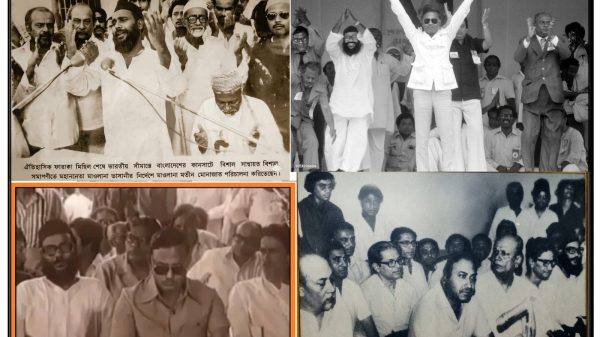
Another important chapter of his political life is the Farakka movement. He played an active role in the movement to protect national interests when India’s one-sided Farakka Dam became a major threat to Bangladesh’s rivers, agriculture and environment. His participation in the historic Farakka Long March held in 1976 under the leadership of Maulana Abdul Hamid Khan Bhasani was very significant.
He led prayers and prayers in that historic gathering held at Kansat in Chapainawabganj. But his role was not only formal but he took a strong stand politically on the question of protecting national resources and people’s rights. Through the Farakka movement, he proved that not compromising on the question of national interest is the main characteristic of a responsible politician.
Maulana Abdul Mateen was a very simple and principled person. In his political life there was no lust for personal interest, luxury or power. He politicized with common people and considered their sufferings as his responsibility. Maulana Mateen’s life style can become an important example when many questions are raised about the relationship of wealth, influence and individualism with politics in the current political reality.The relevance of “Omar-e Communism” philosophy in the current reality of Bangladesh needs to be realized anew. Today, the rich-poor disparity in society is increasing, the cost of living for working people is increasing, youth unemployment has reached alarming levels. At the same time, corruption, political intolerance and social uncertainty are creating frustration among people. In this reality, the questions of justice-based state, accountable governance and humane politics have again come to the fore.
Maulana Mateen believed that the state is not only an administrative structure but also an institution to ensure human security, dignity and justice. He dreamed of a society where religious values, democracy, social equality and national interest would not be in opposition to each other but would reinforce each other.
Another important aspect of his political philosophy was the question of moral leadership. He believed that leadership is not only about getting power but also about being accountable to the people. Without honesty, self-sacrifice and the practice of public welfare in politics, no state can be stable in the long run. This statement has become more relevant in today’s reality.
It is important to highlight Maulana Abdul Mateen’s political life and thoughts to the new generation. Because the contribution of many struggling leaders in the political history of Bangladesh has been hidden with time. But their ideals, political integrity and people-oriented philosophy can provide important directions for future politics.
The 30th death anniversary of Maulana Abdul Mateen is therefore not only an occasion for commemoration but also an opportunity to think afresh about the question of justice-based society and humane state thinking. His philosophy of “Omar-i Samyabad” may not have been established as a full-fledged political framework, but the dream of justice, social equality and welfare state that he showed is still relevant in the political reality of Bangladesh.
There are certain people in history, whose political stance transcends the boundaries of time and becomes an inspiration for the future as well. Maulana Abdul Mateen is one such leader. His life and philosophy remind us that without people’s rights, justice and moral leadership, sustainable peace and welfare cannot be established in any society.I believe that in the light of Maulana Abdul Mateen’s state thinking, Omar-e Communism will guide the new generation in establishing a society based on justice in the establishment of a welfare-oriented state without exploitation, oppression and discrimination. He will live among us in all good deeds and initiatives for ages, this is the success of his life.
Author: Chairman,Bangladesh Labor Party (01711 004277)