মঙ্গলবার, ০২ জুন ২০২৬, ০৬:৩২ অপরাহ্ন



Two great heroes of invincible history: Bangabandhu and Manik Mia
Tafazzal Hossain Manik Miah was one of the few great people who worked as backstage artisans in the history of the emergence of Bengali nationalism and the freedom struggle of Bangladesh. He used journalism not only as a means of delivering news, but as a tool for the liberation of the oppressed people and a sharp weapon of political struggle. As a devoted supporter and guardian of the political philosophy of Bangabandhu Sheikh Mujibur Rahman, he is immortalized in the pages of history.
Born in Bhandaria village of Pirojpur district in 1911, Manik Mia began his journalism career in Calcutta, undivided India, through the newspaper ‘Dainik Ittehad’. He got the true initiation of journalism from the company of Hossain Shaheed Suhrawardy. After partition, he came to Dhaka in 1948 and took charge of editing the weekly Ittefaq. Later, after long preparations, Manik Miah took over the responsibility of regular publication of the newspaper ‘Dainik Ittefaq’ on 24th December 1953. It was the main mouthpiece of Bengali nation’s freedom struggle. Ittefaq was not just the name of a newspaper, it was the embodiment of Bengali aspirations. Later he expanded the scope of journalism by establishing ‘Dhaka Times’ and ‘Purvani’ newspapers. In 1963, he was elected President of the Pakistan Branch of the International Press Institute, an international recognition of his professional excellence.
Manik Mia took journalism parallel to politics. Although not directly active in mainstream politics, he was a huge political force behind the scenes. His timeless column ‘Political Stage’ was the terror of the exploiting classes of that time. Ayub Khan’s military government was also cornered by the brilliance of his writings and the pressure of public opinion. He used to build public opinion in such a way that common people considered Ittefaq as their own voice.
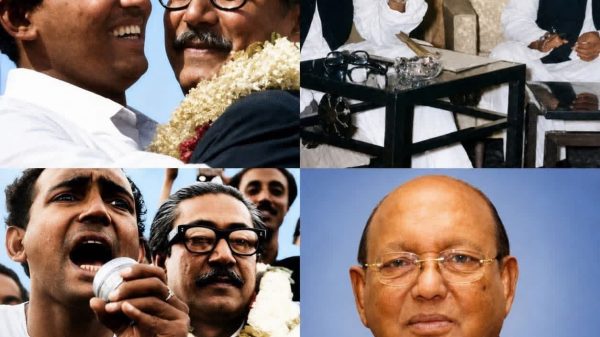
The relationship between Bangabandhu Sheikh Mujibur Rahman and Manik Mia was deep and ideological. Bangabandhu was repeatedly imprisoned, and outside Manik Mia created public opinion in favor of the movement with the writings of Ittefaq. During Ayub Khan’s troubled times, when many people severed ties with Bangabandhu’s family out of fear,Then Manik Mia stood beside them like a guardian. Bangabandhu candidly admitted in his autobiography that Manik Mia’s writings and advice were his main source of courage and guidance in adverse circumstances. Manik Mia’s journalistic foresight was undeniable in transforming the six-point movement into a popular mass movement. After the death of Hussain Shaheed Suhrawardy, Bangabandhu accepted Manik Miyake as his political guardian and most trusted advisor. Bangabandhu always believed that without Manik Mia and Ittefaq, it would have been impossible to protect the independence and identity of East Bengal.
The untimely and mysterious death of this great editor in Rawalpindi on June 1, 1969 shocked Bangabandhu and the entire nation. Bangabandhu did not see Manik Mia’s death as just the death of an individual but as a planned murder. Because, he knew that Manik Mia’s death had created a huge vacuum in the Bengali political consciousness and movement.
Today in the mirror of history Tafazzal Hossain Manik Mia is not only a legendary editor; He is one of the main architects of building the political consciousness of modern Bangladesh and one of the integral co-fighters in building Bangabandhu’s dream of Sonar Bengal. His ideals and writings are still guiding the new generation of journalism profession.
(Manik Lal Ghosh: Journalist and columnist, former associate of Dhaka Journalist Unionpresident)