বৃহস্পতিবার, ২১ মে ২০২৬, ০৫:১৬ পূর্বাহ্ন


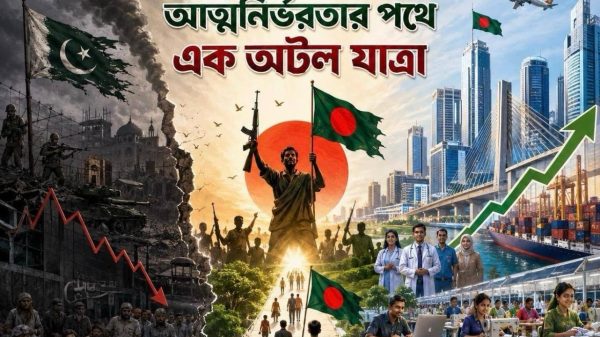

Bangladesh: An Unstoppable Journey from Independence to Self-Reliance
Hakikul Islam Khokan
After the independence of Bangladesh, Father of the Nation Bangabandhu Sheikh Mujibur Rahman started his journey with a ruined economy and limited infrastructure, but over time, it has gradually strengthened its position as a developing economy. The country has achieved significant progress in economic and social indicators through the readymade garment industry, remittance flows, increased agricultural production and human resource development. Bangladesh has also maintained continuous progress in education, health and women empowerment, which has put the country on a path towards stable development.
Under the leadership of Awami League, Bangladesh has increased its acceptance in the global arena by maintaining a balanced and cooperative position in international relations and diplomacy. Despite the challenges, the country’s overall progress reflects a consistent self-reliance.
Bangladesh vs Pakistan: A Practical Comparison of History, Identity and Development
Freedom and the birth of the state:
After the end of British colonial rule in 1947, Pakistan was born through the partition of India. It is a state based on religious concepts, where the Muslim majority regions were united to form a separate country. But from the beginning, Pakistan was a geographically bifurcated state, with major differences in language, culture, economy and political thought between the eastern and western parts. As a result, the political and military hegemony of West Pakistan created discrimination and discontent among the people of East Pakistan for a long time.
On the other hand, Bangladesh was born through a long struggle, mass movement and armed liberation war. From the language movement of 1952 to the ignoring of the results of the 1970 general elections and subsequent political deprivation and exploitation, the people of East Bengal staged resistance. This series of movements culminated in the Liberation War of 1971, through which Bangladesh emerged as an independent state. Hence the creation of Pakistan was the result of political division and administrative compromise,There, the independence of Bangladesh was a historic achievement achieved through long struggle and sacrifice to establish the people’s right to self-determination.
National Identity and Cultural Basis:
The national identity and cultural foundations of Bangladesh and Pakistan were formed in completely different historical and social contexts. Bangladesh basically stands on a linguistic and cultural ethnicity. Here, the focus of national identity is the Bengali language, literature, music, folk traditions and thousands of years of Bengali culture. Although religion is an important social element here, it is not the main basis of national identity. As a result, the identity of Bangladesh is largely based on a single language and cultural unity, where Bengali ethnicity is considered as the main identity of the state.
Pakistan’s national identity, on the other hand, is based on religious concepts, with attempts to create a unified state identity centered around Islam. Within Pakistan there are Punjabis, Sindhis, Pashtos, Baluchis and many other ethnic and linguistic groups, whose culture, language and traditions are very different from each other. Despite this diversity, efforts were made to establish national unity by emphasizing a religious identity at the state level. As a result, the cultural base of Pakistan is relatively multi-ethnic and diverse, but it does not stand firmly on a single language or a single cultural trend.
Generally speaking, while the national identity of Bangladesh is consolidated through language and cultural unity, the national identity of Pakistan is based on religion.
Political Development and Governance:
The political development and governance paths of Bangladesh and Pakistan have been forged through very different experiences.
After the independence of Bangladesh, since 1971 as a new state, political system has been developed. Initially attempts were made to establish a parliamentary democracy, but later there was a succession of military rule, political instability and changes in power. After a long political struggle, the parliamentary democratic structure was gradually strengthened in the country. At present, the governance system of Bangladesh is constituted as a democratic republic, where the parliamentary system of government,Electoral politics and central administration play key roles. But in reality, political party competition and concentration of power are still important features of governance.
On the other hand, Pakistan has gone through relative instability politically since its independence in 1947. The country has experienced repeated military coups and direct military rule, which have repeatedly hampered its democratic development. Although Pakistan is constitutionally a federal parliamentary republic, in practice the military’s political influence there has long been very strong. Power tensions between the Center and the provinces and political uncertainty have complicated the country’s governance.
Overall, Bangladesh’s political development has moved towards gradual stability centered around a relatively democratic structure, whereas Pakistan’s political history has been characterized by more military intervention and instability.
Economic Development:
The economic development paths of Bangladesh and Pakistan have developed in different directions just like the political history of the two countries. Bangladesh started its journey after independence in 1971 with a war-torn economy, where infrastructure, industry and foreign exchange base had almost collapsed. In the following decades, the agrarian economy was gradually strengthened by the garment industry, remittances and export-oriented production. Especially in the recent decade Bangladesh economy has achieved significant progress in continuous growth, poverty reduction and foreign exchange earning. However, this period also saw fluctuations in the economy due to inflation, foreign debt and political instability.
On the other hand, Pakistan, despite having a relatively large industrial base after independence, has not achieved economic stability due to prolonged political instability, security crisis and dependence on foreign loans. Although the country’s economy is dependent on agriculture and textiles, strong industrial diversification and consistent growth have been hampered at times. External debt and inflationary pressures have repeatedly weakened Pakistan’s economic structure.
Overall,Bangladesh’s economy has moved towards export-led and human resource-led growth, while Pakistan’s economy has progressed through high debt and internal structural challenges.
Social Development:
The positions of the two countries in terms of social development are not identical—there are major differences, especially in terms of practical implementation and structural progress.
Bangladesh has made continuous improvements in social indicators since independence. The country has made relatively fast progress in education, health, women empowerment and poverty reduction. Expansion of primary education, reduction in infant and maternal mortality, increase in average life expectancy and rural development programs have strengthened the social fabric. Increasing economic participation of women in particular and their greater role in the garment industry has brought about major changes in society. Although there is still poverty, urban-rural disparity and health care limitations, Bangladesh has maintained a steady trend of progress in overall social development indicators.
Pakistan, on the other hand, faces many structural challenges in social development, which have slowed progress in the long run. While there are development programs in the education and health sectors, population growth, regional disparities, security problems and administrative weaknesses have often limited the effectiveness of these initiatives. Women’s labor market participation in particular is relatively low, and the rural-urban divide creates a large gap in social development. While progress has been made in some regions, overall development in social indicators has been uneven and slow.
Overall, Bangladesh has achieved relatively more consistent and extensive progress in social development, whereas Pakistan has not been able to ensure the same level of stable social development due to various structural and regional challenges.
Security and Stability:
In terms of security and political stability, the experiences and realities of Bangladesh and Pakistan are different.Since independence, Bangladesh has developed its security system primarily within the framework of maintaining internal law and order and maintaining state stability. As a result, administrative control is relatively centralized and stability at the national level is easier to maintain. However, political tensions, electoral violence, and sometimes a deteriorating law and order situation—these challenges are occasionally seen in Bangladesh. Yet the overall state structure remains in place, with continuity in the security system.
On the other hand, the picture of security and stability in Pakistan is much more complex and multi-dimensional. The country has long gone through armed conflicts, border tensions, internal security crises and political instability. The country has faced major protracted civil wars or regional separatist conflicts. In particular, separatist movements in some regions, terrorism-related violence and strained Centre-Province relations have affected the security situation, and militant networks around the world operate from Pakistan. In addition, frequent political regime changes and a history of military intervention have further challenged political stability.
Overall, Bangladesh has been able to maintain relatively more consistent internal stability, whereas Pakistan has progressed through a relatively more complex stability situation due to various internal and regional security challenges.
Foreign Policy and Position:
In terms of foreign policy and international standing, the strategic positions of Bangladesh and Pakistan stand on very different realities.
Bangladesh has generally pursued a balanced and multilateral foreign policy. Although the country maintains relations with various powers, it prioritizes trade, development cooperation, labor markets and regional stability rather than being overly dependent on any single power. As a result, Bangladesh tries to maintain a relatively independent and balanced position in international relations.On the other hand, Pakistan’s foreign policy is more dependent on close relations with a few strategically limited powers. Relations with these two global powers, particularly the US and China, form the focal point of Pakistan’s foreign policy. Pakistan’s dependence on these two countries for economic assistance, loans, investment and security cooperation has long been visible. Because of this dependence, Pakistan’s foreign policy is often guided by strategic pressures and practical constraints rather than in balance.
Overall, Bangladesh has been able to maintain a relatively multi-faceted and balanced diplomatic position, whereas Pakistan’s foreign policy is largely driven by dependence on major powers and management of strategic relationships.
All in all, Bangladesh is overcoming its limitations and slowly establishing itself as a developing, promising and self-reliant nation—opening the door to wider possibilities for the future.
We are nobody’s past. We know how to build our own future. Bangladesh has proved that it is possible to build a country with its own strength. Born in freedom, built in dignity,Bangladesh will continue to progress.